Product links on this page go to Amazon. If you buy through them, Milk the Nut earns a commission. How we pick and earn
The first latte with homemade milk is a disappointment: the foam collapses, the milk splits in hot coffee, and the carton you were trying to replace suddenly looks clever. It is clever. Here is what it does and how to get close.
What the carton has
Barista plant milks carry what homemade milk lacks: a gum (gellan or locust bean) that holds the foam, an oil (sunflower or rapeseed) that gives body and glossy microfoam, and an acidity regulator (dipotassium phosphate) that stops the milk curdling in acidic coffee. Homemade milk is nuts and water. It has fewer solids, no stabiliser and no buffer.
Fix one: body
Use the richer ratio. One cup of almonds or cashews to three cups of water, not four; oats at one to three with a spoon of cashews added. More solids, more foam. Cashew milk froths better than almond because the nut grinds completely; a half-and-half almond-cashew milk is the usual compromise.
Fix two: a little fat and a little lecithin
A teaspoon of neutral oil per litre, blended in, gives the microfoam its shine. A quarter teaspoon of sunflower lecithin (sold as a supplement) is the emulsifier that keeps the oil in the milk and the foam standing. Blend both in with the milk, not after.
The curdling
Splitting in the cup comes from acid and heat together. Pour the hot milk into the coffee, not the coffee into the milk; use a lighter roast; or add a pinch of baking soda to the milk, which is what the phosphate in the carton does. Steam to 55 to 60 °C, not higher; plant milks scorch and split sooner than dairy.
On a machine
A no-strain maker that lets you run a thick ratio makes the better steaming milk; the Almond Cow takes a full cup of nuts to 1.5 L or less, and the Nama M1’s blend knob lets you grind longer for a creamier milk.
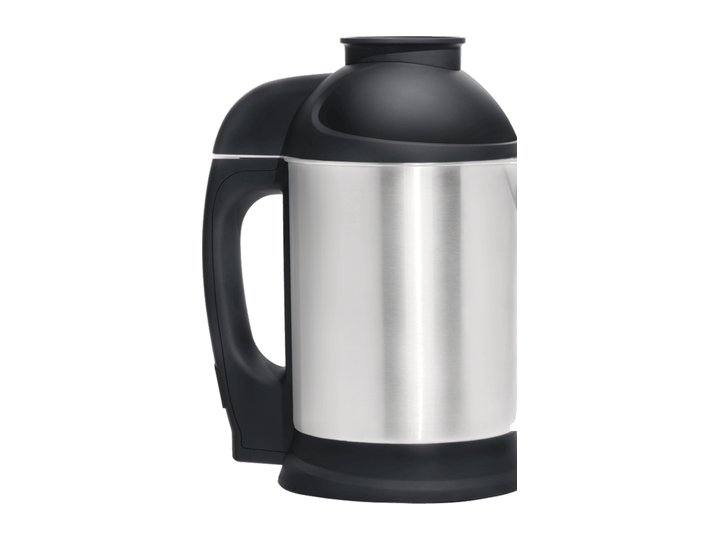
Cold no-strain maker, filter basket, one button
Almond Cow Milk Maker
Almond Cow Almond Cow Milk Maker (120 V)
The machine that made the category: a cup of nuts goes in a stainless filter basket under the motor head, water in the jug, and one press of the cow button spins a pitcher of milk out in about a minute, by Almond Cow's account. Soaking is optional, there is no bag to wring, and nothing heats. The meal stays in the basket and comes out as almond flour.
- Batch
- Up to 1.5 L, about 5 to 6 cups; dry ingredients to the 1-cup line of the basket
- Cycle
- About one minute ("Fresh in 60 Seconds"); soaking optional
- Programs
- One cold cycle, one button; no heating
- Touches the milk
- 304 stainless interior (international page); "food-grade stainless steel and plastic" (US page)
- Motor
- 240 W, 120 V; Almond Cow says 10,000+ rpm
- Size
- 12 × 9.5 × 6.5 in; 4.6 lb
- Warranty
- 1 year, parts and motor
Suits: A household that drinks almond, cashew or oat milk daily and wants the biggest cold batch with the least handling.
Weigh: It makes cold milk only, so soy has to be cooked afterwards on the stove. Almond Cow's own pages disagree on which parts are dishwasher safe (the filter basket on one, all removable parts on another); plan on hand washing. One-year warranty.
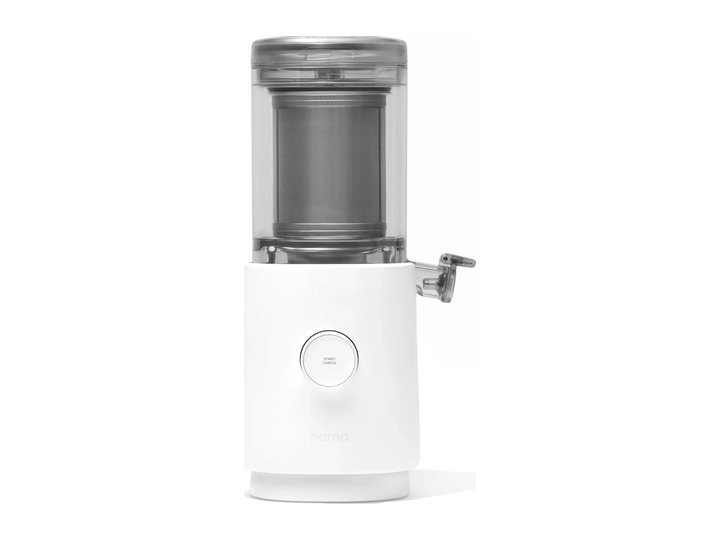
Cold no-strain maker, blend-and-spin, pulp pouch
Nama M1 Plant Milk Maker
Nama M1 Plant Milk Maker
Nama's milk maker from the people behind the J2 juicer: a filter basket in a Tritan chamber, a knob for blend time (creaminess), then a spin cycle that wrings the liquid out of the pulp on its own, and a spout to decant. Nama calls it Blend + Strain; the pulp lands in a fold-to-seal pouch, so there is nothing to scrape. Nama says no soaking is needed; there is no bag and nothing heats.
- Batch
- Not published by Nama; about 32 oz / 0.9 L (reviews)
- Cycle
- Blend time set by the knob, then an automatic spin cycle; about two minutes (reviews)
- Programs
- Adjustable blend, auto spin, spout to decant; no heating
- Touches the milk
- Tritan chamber, stainless strainer mesh, glass-filled nylon and stainless blade cage
- Motor
- 600 W; blend 10,000 rpm, spin 2,500 rpm
- Size
- 8.7 × 7.3 × 16.3 in; 11.9 lb with chamber set
- Warranty
- 15 years on all parts
Suits: Anyone who wants control over texture (the knob sets how long it blends) and a machine built to last: Nama publishes a 15-year warranty on all parts.
Weigh: Nama publishes no batch size or cycle time; reviewers report about 32 oz and about two minutes. The chamber is Tritan, a plastic, if that matters to you. No heating element, so soybeans must be fully cooked before they go in (Nama's support page says so). Hand wash with the included brush.
Heated makers with a keep-warm hand you milk already at steaming temperature; the Kidisle 32 oz holds it for two hours, and the froth comes from a hand frother or the espresso machine’s wand.
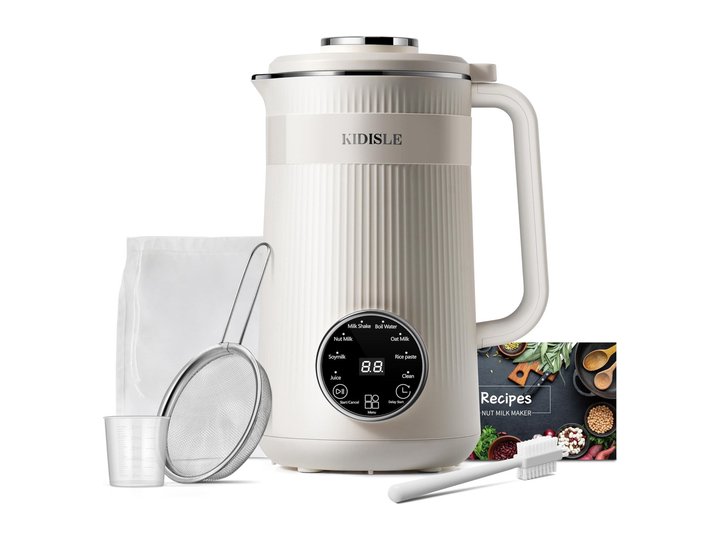
Heated multi-cooker, 32 oz, eight programs
Kidisle 8-in-1 Nut Milk Maker, 32 oz
Kidisle 8 in 1 Nut Milk Maker Machine, 32 oz
The household size of the Kidisle line: a stainless jug on a heated base with eight touch-panel programs covering soy, almond, oat and coconut milk, rice paste, boil water and a self-clean, plus a delay start and a keep-warm of up to two hours. It ships with a fine mesh strainer and a nut milk bag for the people who want their almond milk smoother than the grinder leaves it.
- Batch
- 32 oz (listing)
- Programs
- Soy, almond, oat and coconut milk, rice paste, boil water, self-clean; delay start; keep warm up to 2 h (listing)
- Heats
- Yes
- Touches the milk
- Stainless jug, 10 stainless blades (listing)
- Power
- 800 W, 120 V (listing)
- In the box
- Fine mesh strainer and nut milk bag (listing)
- Size
- Listings disagree: 5.1 × 5.1 × 11 in or 7.8 × 7.8 × 12.8 in; about 4.2 lb
Suits: A family that drinks soy or oat milk by the jug and wants it cooked, warm and ready at breakfast on the delay timer.
Weigh: Kidisle publishes no spec sheet; every figure here is from the listing, and listings disagree on the size. The jug is rinsed by hand, never in the dishwasher. The grind is not a filter: strain for smooth almond milk.
Froth it cold
A hand frother in cold milk, 20 seconds, then warm the glass in the microwave: cold foam holds better on homemade milk than steamed foam does. It is the trick most home baristas on plant milk end up using.
The ratios for every milk are in the ratios guide; the machines are on the no-strain and heated pages.